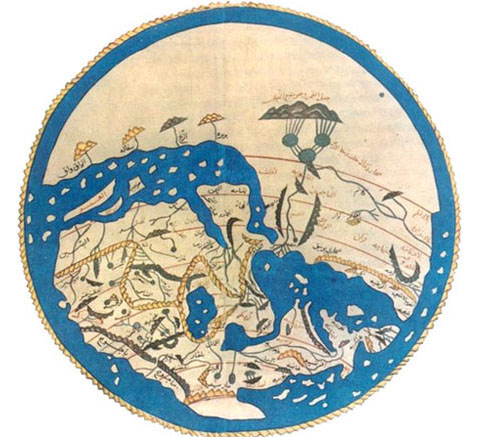
The Mediterranean Seminar Prize for the Best Book in Mediterranean Studies, 2026
The 2026 prize for the best book covered scholarly and trade publications published from 2020 to 2022 inclusive. The committee was most interested in books that broke new ground conceptually or methodologically, were comparative and/or interdisciplinary, that emphasized the intercultural/interregional/inter-religious contact, and that were “of” rather than merely “in” the Mediterranean. Although we focussed on the pre- and Early Modern, books ranging from any period were considered. Books from any of the relevant Humanities and Social Sciences disciplines were welcome, including but not limited to all fields of history, art and material culture, literary and cultural studies, anthropology, and sociology. The Mediterranean is broadly construed as the region centered on the sea, but including connected hinterlands in Europe, Sub-Saharan Africa, the western Indian Ocean, the Near East and Central Asia.
The next round of the Best Book Prize will be held in 2026 and will include books published from 2026 to 2028, inclusive.
The next round of the Prize for the Best Source Edition, Book Translation, or Essay Collection will be held in 2028, for books published from 2025 to 2027. The next prize competition for the Best First Book (published from 2024—2026) will be announced in July.
The committee for the 2026 Prize for the Best Book was:
• Brian A. Catlos: Religious Studies, University of Colorado Boulder
• Sharon Kinoshita: Literature, University of California Santa Cruz
• Dwight Reynolds: Religious Studies, University of California Barbara
The committee received a great number of highly original and sophisticated entries, a sign of the dynamism of our now-maturing field. There were a number of book which were of truly exceptional quality; nevertheless the committee concurred that the three entries below stood out and merited particular distinction.
Thank you to everyone who submitted entries; your scholarship is appreciated, and we wish you continuing successes.
Co-Winner
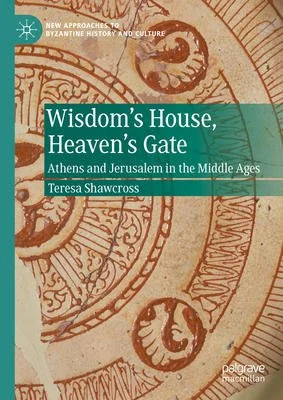
Shawcross, Teresa. Wisdom’s House, Heaven’s Gate: Athens and Jerusalem in the Middle Ages (Cham: Palgrave Macmillan, 2024)
Teresa Shawcross’s Wisdom’s House, Heaven’s Gate: Athens and Jerusalem in the Middle Ages is a tour-de-force of early medieval Mediterranean history. Through a study of the two showcase cities – one the former epitome of pagan wisdom then under Christian rule, and the other the epicenter of Christian faith then under Muslim dominion – we see that far from representing incompatible and alien cultures, Fatimid Egypt and Macedonian Byzantium were inextricably bound together in discourses of political and religious competition that reflected their common roots in the Hellenistic Abrahamic ferment of the Mediterranean world. Shawcross examines the transformation of these two paradigmatic cities over the course of the early Middle Ages, and in the wake of the messianic Isma’ili caliph al-Hakim’s destruction of the Church of the Holy Sepulcher. The latter event served as the catalyst for Byzantium’s resurrection of the city that was the nucleus of ancient Greek pagan learning into a new Jerusalem, and the reconfiguration of its Temple of Athena as the new Temple of the Abrahamic tradition. Shawcross traces the engagement of and resonance between the Roman Empire of Constantinople and the insurgent caliphate of Cairo through using an array of sources in Greek and Arabic as well as architecture and material evidence. This is a story not only of politics but of people, in which the interaction of the two empires was driven not only by the priorities of state and by the agendas of their rulers, but by the engagement of Christian and Muslims who moved back and forth across the shifting frontiers of these realms. Bridging disciplines and linguistic and religious cultures, Wisdom’s House, Heaven’s Gate is a model of how to approach the history of this complex and dynamic world, demonstrating how Mediterranean Studies approaches can generate illuminating and original conclusions by interrogating canonical historiographical paradigms.
Co-Winner
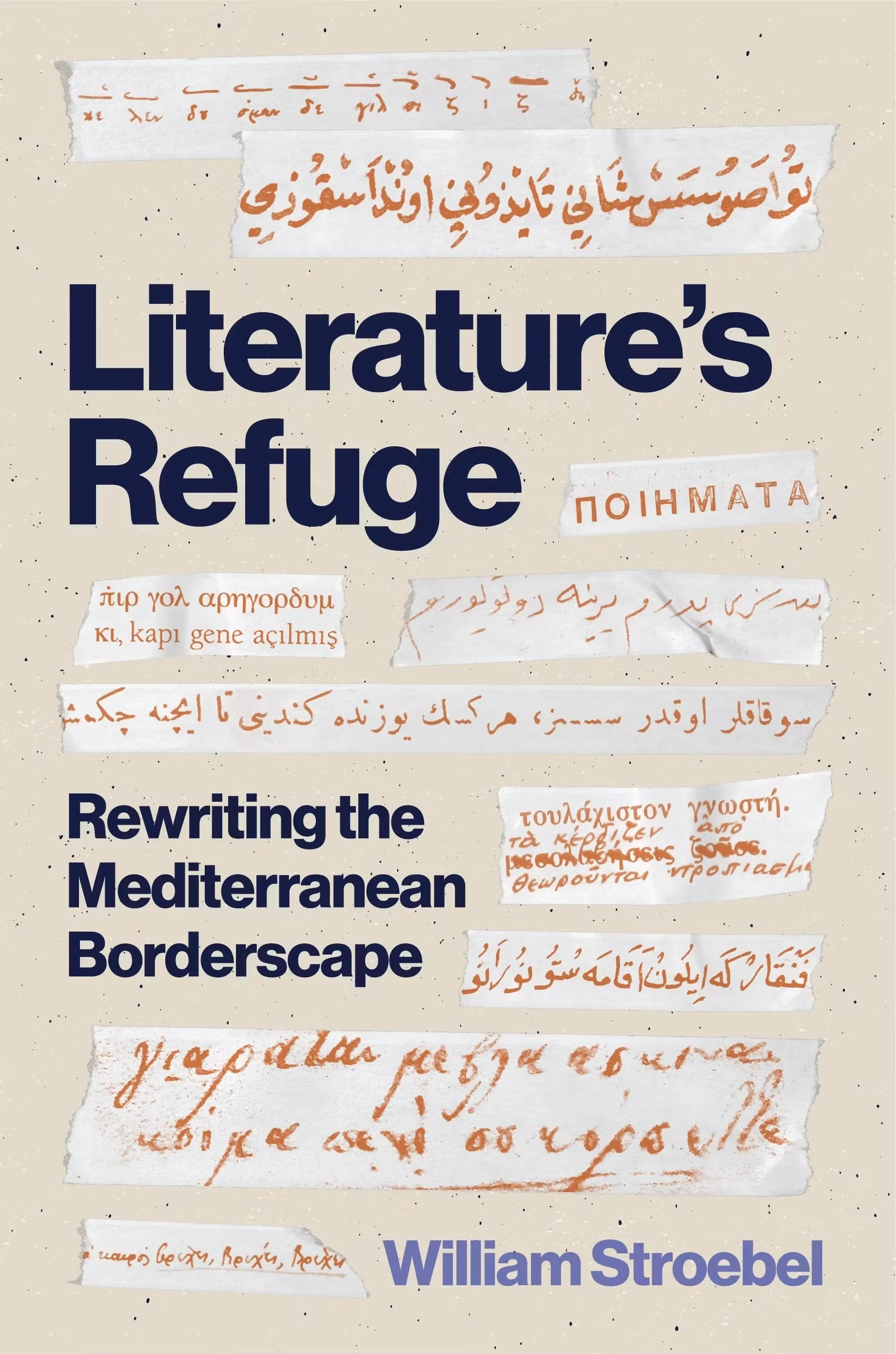
Stroebel, William. Literature’s Refuge: Rewriting the Mediterranean Borderscape (Princeton: Princeton University Press, 2025).
The 1923 Greco-Turkish population exchange is well-known to historians as a signature event that marked the transition from an age of empires to the regime of the modern nation-state in the aftermath of the First World War. In Literature’s Refuge: Rewriting the Mediterranean Borderscape (Princeton, 2025), William Stroebel brings a literary historian’s eye to “alternative cultural imaginaries”—the hidden stories and storytellers—that fell victim to this political and ideological reterritorialization while illuminating its cultural complexity. Exposing “literature” as a construct resulting from philological practices of “inclusion, exclusion, extraction, and the production of institutional value” (particularly as mediated by the printing press), Stroebel sets out to “document philology’s undocumented”: “refugee and diasporic narratives” that survive in unpublished manuscripts or marginalia. These include texts—Islamic poetry composed in Greek in the Arabic script, novels written in Turkish in the Greek script—that would surprise no one familiar with the cultural history of empires but have been made illegible through the Procrustean bed of modern national literary canons. Socio-historically engaged and theoretically informed, Literature’s Refuge remaps literary geography by dismantling hierarchical distinctions between such “refugees” (often in mixed or non-standard dialects) and celebrated works like those of the diasporic Alexandria-born poet Constantine Cavafy, which it places in “horizontal solidarity.” The book concludes with Cypriot writer Mehmet Yashin’s 2003 novel Sınırdısı Saatler (The Deported Hours), a postmodern fiction about a Karamanlı (late Ottoman-era Turkish written in Greek script) refugee in search of the author, “Mehmet Yashin,” who has resurrected him in twenty-first century Turkey. Foregrounding the violence and loss inherent in the imposition of borders of all kinds, Literature’s Refuge magisterially demonstrates the centrality of literary politics to modern Mediterranean history.
Honorable Mention
Kosmin, Paul J. The Ancient Shore (Cambridge: The Belknap Press of Harvard University Press, 2024).
The Ancient Shore invites readers to move beyond the Mediterranean’s aquatic connections to contemplate the shore not simply as a boundary between land and sea but as a particular type of geographical space “central to the economic, political and social dynamics of the ancient Mediterranean and west Asia and to the inner life of their inhabitants.” Focusing not on any one shore, Paul J. Kosmin takes the shore as a lens through which to rethink historical and natural processes in the Mediterranean and beyond--from Atlantic Iberia to South Asia--from the Late Bronze Age to the High Roman Empire, but focusing primarily on the Hellenistic age. Part One, “Unity,” draws on Greek texts and archaeological evidence (such as multilingual cave graffiti on the island of Socotra) to argue for the emergence of a “Eurasian globality” that joined the economic activities of the Mediterranean and the Indian Ocean. Part Two, “Claim-Making,” examines attempts to establish terrestrial authority over the resources of Mediterranean shores through means such as the construction of lighthouses, as well as interstate political and legal tensions over trade restrictions, landing rights, the practices of shipwreck salvage, and the suppression of local coastal resistance such as pirates. In the third chapter, “Cosmos,” Kosmin considers how Hellenistic writers viewed the shore as a site for contemplating the place of humans in the natural world This volume offers the field of Mediterranean Studies a number of potentially productive new insights into how earlier cultures understood and interacted with the ambiguous and at times precarious zone of contact between land and sea.