The Spring 2026 Mediterranean Seminar Workshop
22 & 23 May: University of Oregon, Eugene
Food and Foodways
Across the Mediterranean World
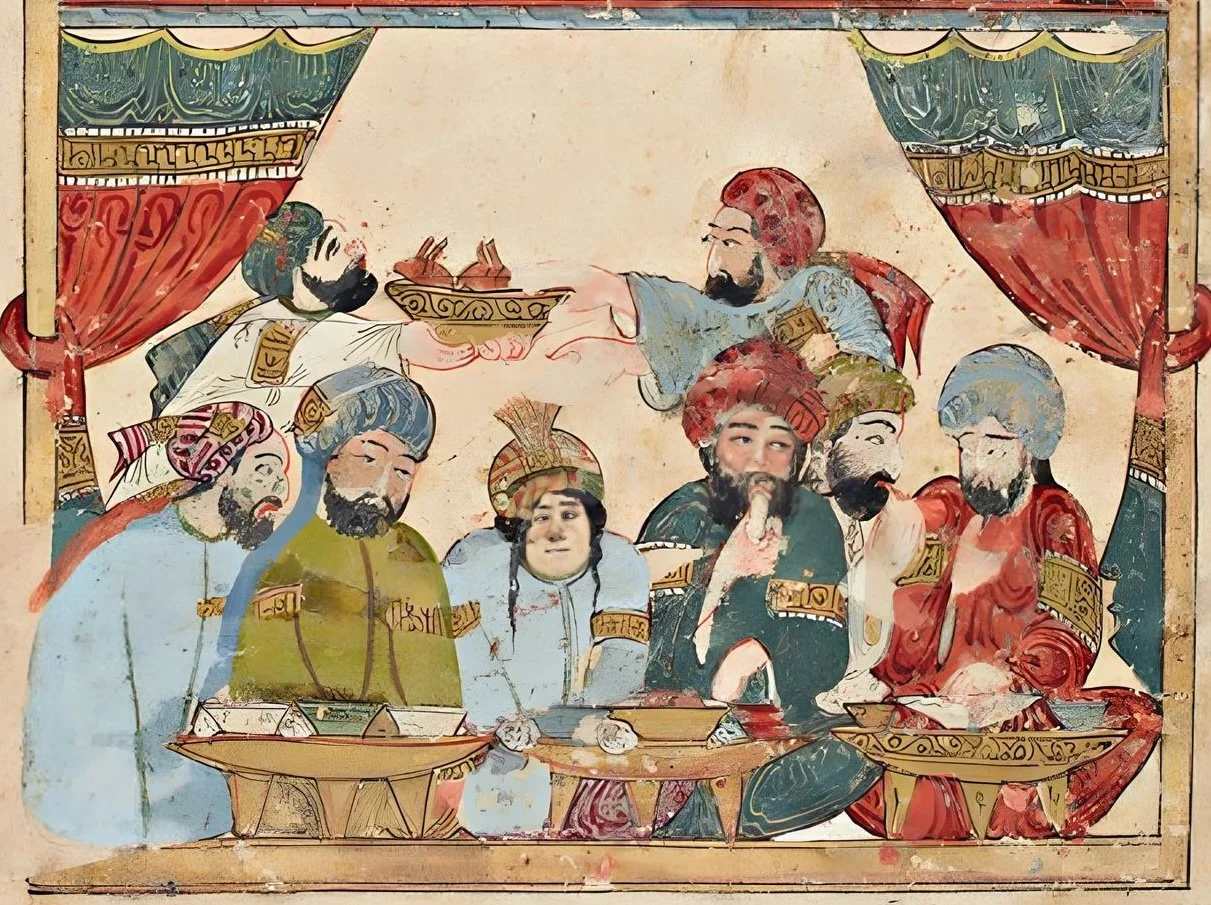
Food is fundamental to the human experience, and some would argue, a defining feature of the historical and cultural Mediterranean. After all, for Braudel, the Mediterranean was the “land of the vine and olive.” Some today extol the “Mediterranean diet,” while others dismiss it as a marketing artifice. Whatever the case, what we consume is at times held to define us. Food can separate us, but it also joins us together. Religious and social rituals prescribe what is to be eaten and how, when and with whom, and what foods are not to be eaten, when and with whom. And yet food is also a leveler, joining people of diverse identities in fellowship in one of life’s most basic and pleasant activities. Feasting marks our greatest occasions. The production, distribution and consumption of food has shaped and transformed societies, economies and ways of seeing the world. It is deeply bound up in colonization and conquest and often drives diplomacy. Armies march on their bellies. The need for staples and desire for luxury food bound together the interests of the Christian and Muslim Mediterranean and their global hinterlands. While we seldom eat our enemies, we do often covet their food, and sometimes we bring our own to the feast. From the medieval Islamicate “Green Revolution” to the stream of spices coming in along the “Silk Roads,” to the culinary transformations of the Colombian Exchange, the Mediterranean has been a crucible of culinary innovation and food looms large in our image of the Mediterranean and in the mind of its inhabitants.
Program & Papers
All papers [click on the title to download] are copyright the author and are not to be copied, distributed or cited without express written permission by same.
Click on the participant name to see their bio.
Friday, 22 May 2026
Location: 403 UOAA Past Presidents Executive Board Room, Ford Alumni Center
9:45-10:15 Coffee and Registration
10:15-10:30 Opening Remarks
• Aneesh Aneesh (Director, Schnitzer School of Global Studies and Languages, University of Oregon)
• Brian A. Catlos (Religious Studies: University of Colorado Boulder)
• Sharon Kinoshita (Literature Emerita: University of California, Santa Cruz)
10:30—11:45 Workshop Paper #1
Moderator: Brian A. Catlos (Religious Studies: University of Colorado Boulder)
”From Symposium to Bazm: Feasting Rhetoric in Greek and Iranian Epic” [abstract]
• Hessam Abedini (Comparative Literature: University of Oregon)
Respondent: William Granara (Near Eastern Languages: Harvard)
11:45-12:00 Introductions
12:00–1:30 Lunch (for speakers and registered participants)
1:30-2:45 Workshop Paper #2
Moderator: Sharon Kinoshita (Literature Emerita: University of California, Santa Cruz)
”Food, Words and Power: At Dinner with Ibn al-Khatīb, Ibn Khaldūn and Sultan Muhammad V on Monday, January 9, 1363 (22 Rabi’ 1, 764)” [abstract]
• Allen Fromherz (History: Georgia State University)
Respondent: Fred Astren (Jewish Studies Emeritus: San Francisco State University)
2:45-3:00 Coffee Break
3:00-4:15 Workshop Paper #3
Moderator: David Wacks (Romance Languages, University of Oregon)
”Harīsa-on-Sea: Prayers from the Eastern Mediterranean “ [abstract]
• Su Hyeon Cho (Oriental Studies, Oxford)
Respondent: Sergio La Porta (Education and Human Development: Fresno State)
4:15-4:30 Coffee Break
4:30-5:45 Keynote Presentation
“Food Fit for a King: What the 1611 Cookbook Teaches Us about Early Modern Spanish Foodways” [abstract]
• Carolyn Nadeau (Spanish/World Languages: Illinois Wesleyan University)
Moderator: David Wacks (Romance Languages, University of Oregon)
6:30-8:30 Dinner (see below) for workshop presenters, moderators, and round-table presenters
9:00— Post-workshop meeting (see below)
Saturday, 23 May 2026
Location: 403 UOAA Past Presidents Executive Board Room, Ford Alumni Center
9:30–10:00 Coffee and Registration
10:00–11:15 Round Table 1
- Production and Distribution:
How were crops, products, ingredients and techniques of food production developed and disseminated across the Mediterranean world? How did production, dissemination and consumption of food shape Mediterranean economies and how did this intersect with specific communities and constituencies?
Moderator: Brian A. Catlos (Religious Studies: University of Colorado Boulder)
• Travis Bruce (History: McGill)“The (Im)Moral Economy of Maritime Grain Theft in the Fourteenth-Century Crown of Aragon” [abstract]
• Heather Crowley (History: Monterey Peninsula College) “A Mediterranean Flavor: Food and Economics in a Medieval Borderland“ [abstract]
• Jasmine Samara (School of Law: University of Oregon) “Food, Law, and Borders in the Mediterranean: the case of Halloumi cheese in Cyprus“ [abstract]
• Nicole Archambeau (History: Colorado State University Fort Collins) “Feeding Humans and Honeybees with Mediterranean Plants“ [abstract]
11:15-11:30 Coffee Break
11:30–12:45 Keynote Presentation
”A Mediterranean Nightshade: Tomatoes, Trade, and Travel over the Longue Durée” [abstract]
• Anny Gaul (Arabic Studies: University of Maryland)
Moderator: Sharon Kinoshita (Literature Emerita: University of California, Santa Cruz)
12:45–2:00 Lunch (for speakers and registered participants)
2:00—3:15 Round Table 2
- Consumption and Culture
Was there a “Mediterranean diet”? What was it and how did it evolve? What role did food have in social and cultural practices, and secular and religious rituals? What were the various manifestations of Mediterranean food culture and how did these vary over time, place and across ethno-religious communities?
Moderator: Sharon Kinoshita (Literature Emerita: University of California, Santa Cruz)
• Fred Astren (Jewish Studies Emeritus: San Francisco SU) “A Business Dinner Gone Wrong in Merovingian Francia” [abstract]
• Houssem Chachia (University of Tunis & Near Eastern Studies: Harvard University) “Blessed Food: The Power of Feeding in the Qashāshiyya Zawiya of Early Modern Tunisia” [abstract]
• Erdem Idil (History: University of Toronto) “From Privilege to Profit: The Origins and Afterlives of Venetian Wine in Early Modern Istanbul“ ( [abstract]
• Courtney Kealy Religious Studies: Wofford College) “Culinary Heritage and Gendered Agency: Women’s Foodways in Hamamönü, Ankara“ [abstract]
• Michelle al-Ferzley (Beinecke Library: Yale University) ”Humoral Harmonies: ‘Humoral Harmonies: ‘Port Saint Symeon Wares’ through Islamic Medico-Culinary Texts” [abstract]
3:15-3:30 Coffee Break
3:30—4:45 Round Table 3 - Perceptions and Representation
How was food viewed and depicted in art and across the various genres of literature (including fiction and non-fiction, prose, poetry, and scientific, moral or religious texts)? What particular dynamics and tensions did this produce?
Moderator: David Wacks (Romance Languages, University of Oregon)
• Madera Allan (Spanish: Lawrence University) “Stone Bread: Hospitality on the Camino de Santiago” [abstract]
• Sara Gardner “Fruit of the Vine, Fruit of the Verse: Wine, Viticulture, and the Terroir of Golden Age Hebrew Poetry in Spain“ (Spanish: University of Minnesota) [abstract]
• William Granara (Near Eastern Languages : Harvard) “The Last Supper” [abstract]
• Nina Zhiri (Literature: University of California, San Diego) “Food in Early Modern Moroccan Travel Accounts to Spain” [abstract]
4:45—5:15 Concluding Remarks
• David Wacks (Romance Languages, University of Oregon)
• Sharon Kinoshita (Literature Emerita: University of California, Santa Cruz)
• Brian A. Catlos (Religious Studies: University of Colorado Boulder)
6:30—8:30 Dinner (see below) for workshop presenters, moderators, and round-table presenters
9:00— Post-workshop meeting (see below)
Participants
• Gantt Gurley (Clark Honors College, University of Oregon)
• Viana Hara (Romance Languages and Indigenous, Race, and Ethnic Studies, University of Oregon)
• Mary Jaeger (Classics, University of Oregon)
• Eileen Morgan (Graduate School in History of Arts, Università Ca' Foscari Venezia)
• Kris Seaman (Art and Architecture, University of Oregon)
Practica
Arrival:
From Eugene airport, take a taxi or ride-share (±$35) or Amtrak bus 99 Vine ($14) 2 stops (20 mins) to Jacqua Academic Center and walk 4 mins to Hayward Inn.
Accommodation:
Hayward Inn, 1759 Franklin Blvd, Eugene, OR 97403 • https://www.haywardinneugene.com/
Parking:
13th Ave Garage, 1355 Columbia St, Eugene, OR 97403 https://map.uoregon.edu/parking
Parking instructions
Wifi:
UO Guest (self-register) or eduroam
https://service.uoregon.edu/TDClient/2030/Portal/KB/ArticleDet?ID=34557
Lunches:
Lunches are provided free to participants.
Local contacts
Organizer: David Wacks • 541-206-8874 • wacks@uoregon.edu
Marci Viano-Davis, Operations Manager, Schnitzer School of Global Studies and Languages • 541-346-4019 marcid@uoregon.edu
Sponsors, Organization & Support:
This workshop is organized by Brian A. Catlos (University of Colorado Boulder), Sharon Kinoshita (University of California Santa Cruz) and David Wacks (University of Oregon). It is sponsored by the University of Oregon’s Schnitzer School for Global Studies and Languages, Oregon Humanities Center, Department of Romance Languages, Italian Program, Global Justice Program, Rutherford Middle East Initiative, Global Studies Institute, Department of Religious Studies, Food Studies Program, Harold Schnitzer Family Judaic Studies Program, European Studies Program, Department of History of Art and Architecture, Department of History, and Department of Comparative Literature, together with the Mediterranean Seminar and the CU Mediterranean Studies Group.