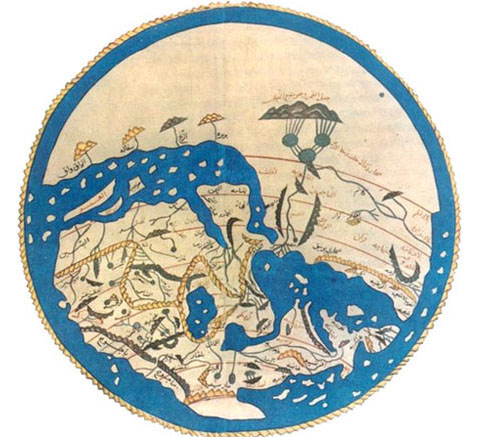
“The Archivo General de Simancas: An Introduction”
Mediterranean Studies Summer Skills Seminar
13—16 July 2026 • Remote
The Summer Skills Seminar, “The Archivo General de Simancas: An Introduction” will be held via Zoom from Monday, 13 July to Thursday, 16 July 2026 from 10am to noon and 1pm to 3pm MDT.
EXTENDED REGISTRATION UNTIL JULY 9
APPLY HERE
This seminar offers an introduction early Modern Spanish paleography and the organization of the General Archive of Simancas and an insight into the rich sources of the Spanish monarchy in the sixteenth and seventeenth centuries. Using a hands-on approach, students will learn to analyze original documents and to read and transcribe sources in early modern Spanish and in other languages, enabling students to read documents at the AGS and from across the global empire of Early Modern Spain.
Course overview
Since 1540, the Archivo General de Simancas (AGS) has kept the memory of the Spanish Monarchy in a medieval castle near the city of Valladolid. The documents comprise more than 13 kilometers of files ranging from the fifteenth to the nineteenth centuries, with more systematic holdings from the sixteenth and seventeenth centuries. As an administrative archive of the Monarchy, the AGS is organized according to the councils and institutions of the Spanish dynasties. Among many other topics, this collection includes detailed diplomatic negotiations with European powers, the administration of Spanish, Portuguese, Italian, and Dutch territories, the management of war and the royal treasury, as well as maps and plans as the Spanish Monarchy became the first global empire. Although most of the documentation relating to the Americas and the Pacific is located in the General Archives of the Indies (Seville), the AGS almost monopolizes the collections devoted to Europe and the Mediterranean and the Islamicate world, from Morocco to Persia.
The seminar combines several approaches and skills:
1) Understanding the institutional logic of the Spanish Monarchy to learn what was documented and how and where it was organized.
2) Identifying the typology of the documents and their standardized sections and contents.
3) Introducing early modern Spanish paleography with special emphasis on abbreviations, dates, numbers, places, and names.
The seminar’s structure aligns with the typical phases of a researcher’s work, from the initial selection of a topic and identification of relevant archival sections to the subsequent reading and editing of sources. The approach is highly practical, developing skills to search and read authentic documentation using PARES, the online portal of Spanish archives. While the majority of the documentation is in Spanish, there are also a considerable number of texts in Italian, Latin, French, and even Arabic and Greek. The contents of the seminar will be adapted as much as possible to the students’ needs and interests. The objective is to provide tools and techniques to successfully utilize the AGS documentation for a wide range of research projects, as well as for other studies conducted at the various Spanish State Archives that utilize PARES, the Spanish archives web portal, where you can access images of documents online from any location.
Students who complete the course will receive a certificate attesting to their work in this area. Learning to read early modern documents can certainly improve your Spanish and your understanding of old literature, as well as be of use in the job market. In addition, skills in paleography will allow students to deal with many of the premodern manuscripts in Romance languages and will make a difference in research work. We also hope that understanding the inner logic of the Simancas archive will enable students to address novel global and imperial topics.
This Summer Skills Seminar builds on the experience of earlier editions, which participants described as “transformative” in terms of their research, and which provided them with an opportunity to network and lay the foundations for future collaborations. For information and participant reviews of our former Skills Seminars see here.
Past participants said:
“This was very helpful exposure to paleography. I felt I did not have the control of early modern Spanish language and experience with paleography to keep up with some of the classmates but I still feel as though I walked away having learned much from the course.”
“Professor Rubén González Cuerva was wonderful! The course was well organized, and Professor González Cuerva made approaching the documents fun and accessible, giving us tips to help us read the handwriting and piece together words that we might not have recognized at first look. He also clearly explained the archival system at Simancas and showed us many ways to use PARES effectively. Lastly, he offered us many resources including lists of early modern dictionaries to help us understand what we read.”
“I was impressed by how meticulously planned out the course was. Each hour was thoughtfully prepared, and I never felt like time was 'wasted.' I thought the four days rather than five were perfect, and I didn't feel burnt out by the end of the week.'“
“Ruben was wonderful! Engaging, encouraging, he and highly proficient in navigating the archives and in helping us work through paleographic texts”
“I found Professor Rubén extremely knowledgeable and eager to make the course relevant for the students in the course. He went above and beyond to answer absolutely every question students had and never made us feel silly when we needed a review or a slowing down of the content. He did a great job keeping us engaged across the 16 hours. I hope to cross paths with him in person in the future!”
“The instructor was warm, patient, and clearly knowledgeable, and I especially appreciated how he incorporated student interests into his teaching. One small suggestion for improvement would be to explore ways of encouraging broader participation. When questions were posed to the whole class, a few students tended to dominate the conversation. It might be helpful to occasionally call on students directly, in addition to asking for volunteers, to ensure that everyone has a chance to engage and contribute.”
“Ruben was a great instructor, who is very experienced and well educated on the subject. Also he was superb in his way of teaching the course! Overall a great learning experience and great materials to help through future projects! Thank you very much!”
Faculty

The course will be conducted by Prof. Rubén González Cuerva (Early Modern History, Spanish National Research Council). A graduate of the Autonomous University of Madrid (PhD, 2010) and now a historian of early modern Euro-Mediterranean diplomacy, González Cuerva has been using the collections of the AGS since 2006, primarily for research into Habsburg intra-dynastic relations and the foreign policy of the Spanish Monarchy. His books include Baltasar de Zúñiga. Una encrucijada de la Monarquía hispana (1561-1622) (Polifemo: 2012), (with Alexander Koller) A Europe of Courts, a Europe of Factions: Political Groupings at Early Modern Centres of Power (1550 – 1700) (Brill: 2017), (with Miguel Ángel de Bunes Ibarra) Túnez 1535: voces de una campaña europea (CSIC: 2017), (with Francesco Caprioli) Reconocer al infiel: la representación en la diplomacia hispano-musulmana (siglos XVI y XVII) (Sílex: 2021), Maria of Austria, Holy Roman Empress (1528-1603): Dynastic Networker (Routledge: 2022), (with Manuel Borrego and Giuseppe Mrozek-Eliszenski) Les Favoris dans l’Europe du XVIIe siècle: Discours et representations (Presses de l’Université de Franche-Comté, 2025) and (with Francesco Caprioli) Beyond Sovereign Courts: Agents and Practices in Early Modern Spanish and Habsburg Diplomacy (Brepols: 2026) and he has written 75 more chapters and articles in 6 languages. He has held the Marie Curie Fellowship and has been Leonardo Fellow.
Prerequisites and preparation
There are no prerequisites for this workshop.
Applicants should have a good reading knowledge of modern Spanish. The language of instruction is English.
Sample documents:
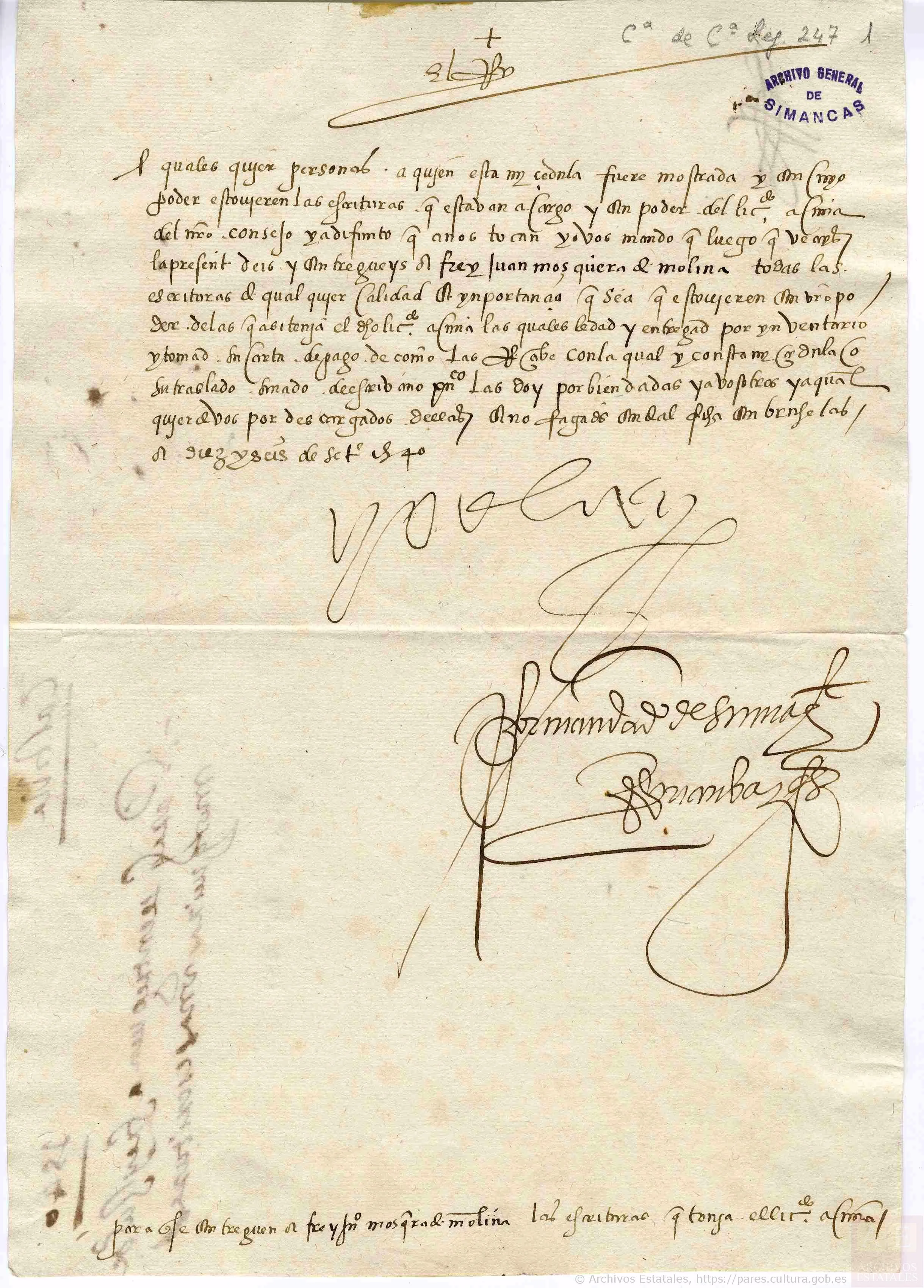
AGS, CCA, LEG, 247, f.1r
AGS, EST, LEG, 3594, f.64r
AGS, EST, LEG, 3594, f.64v
AGS, PTR, LEG, 11, f.170r
transcriptions
Please note: sessions will not be recorded; synchronous attendance is required.
Application & Information
The regular application period is until April 26.
There is an application deposit of $100USD or €100. This will be refunded when course payment is made.
Late applications will be accepted if there is availability and will be subject to a late fee.
If you are not accepted your application deposit will be refunded.
Applicants will be advised of acceptance by May 1. Payment is due on 15 May. Applicants waiting on a grant or subvention should contact us without delay to make arrangements.
Late applicants may be accommodated if space remains. For late applicants full payment will be due within three days of acceptance, including a $75 surcharge for late applications, or be subject to an additional fee.
All payments are final and non-refundable. A letter of confirmation/ receipt will be provided by the Mediterranean Seminar, together with a certificate of completion once the course has concluded.
NOTE: Numbers are limited; participants are encouraged to apply early.
Fees
There has been no increase in fees for 2026
• $1100 for Full Professors, Librarians & Professionals
• $825 for tenured Associates, Emerita/us, Retired Faculty, Independent Scholars & Non-Academics;
• $575 for non-tenured Associates and Assistants, Postdoctoral Fellows & Graduate and Undergraduate students;
• $400 for Adjuncts, Lecturers & Contingent faculty.
Limited reductions are offered to applicants who are (1) nationals; (2) current residents; (3) AND faculty or students in low-per-capita GDP countries may apply for a reduction (the Low-GDP Bursary program).
Payment information will be provided at the time of acceptance. Posted fees do not include a 5% processing fee.
How do we determine our fees?
Why have our fees gone up
Can I get a reduction in fees?
What is the low-GDP Bursary program?
Program
Monday, 13 July 2026
10am to noon and 1pm to 3pm
1. What’s in the castle? An introduction to the General Archives of Simancas
2. Online research: searching and reading with PARES
Tuesday, 14 July 2026
10am to noon and 1pm to 3pm
1. It’s my first day… Strategies and practices for using the archive
2. Knowing and reading the “State” section
Wednesday, 15 July 2026
10am to noon and 1pm to 3pm
1. How much is lxqclxiiiUdccxii mrs? Numbers and economics
2. Knowing and reading the “War and Marine” section
Thursday, 16 July 2026
10am to noon and 1pm to 3pm
1. What else? Administrative sections and other archives
2. Transcribing and editing original sources
Important dates:
Application period: 26 April 2026
Acceptance/stand by notifications: 5 May 2026
Full payment: 12 May 2026 (subject to extension for late applicants/ or pending grants)
NOTE: Numbers are limited; participants are encouraged to apply early.
Information
For general information regarding fees, enrollment, and administrative matters, contact the Mediterranean Seminar; for questions regarding seminar content and materials, contact the instructor directly.