“Medieval Mediterranean Coinage: An Introduction”
Mediterranean Studies Summer Skills Seminar
22—25 June 2026 • Remote
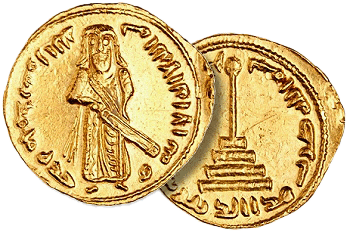
The Summer Skills Seminar, “Medieval Mediterranean Coinage: An Introduction” will be held via Zoom from Monday, 22 June to Thursday, 25 June 2026 from 10am to noon and 1pm to 3pm MDT.
EXTENDED REGISTRATION UNTIL JUNE 17
This Summer Skills Seminar will introduce participants to the dynamic interactions of Roman and Sasanian coinages in the Late Antique period, which gave way to the tripartite division of Latin, Byzantine, and Islamic coinages of the succeeding centuries. We will examine how these three coinages developed and interacted through the later medieval centuries, laying the groundwork for the modern monetary systems.
Each student will choose a coin of the period from an online or personal collection and share with the group the circumstances of the minting of the coin, the state of scholarship on the coinage, and a report on the circulation of the coinage from the evidence of hoards and excavations. Major analytical methodologies will be explained along with a chronological survey of Mediterranean coinages from the sixth through fifteenth centuries. No prior experience with numismatics is expected.
Course overview
Coinage was a part of the lives of virtually all inhabitants of the regions around the Mediterranean from late antiquity to the later Middle Ages. Coins served as a means of pay, of commerce, of savings, and were one of the few emanations of their government that medieval people experienced in daily life. This course will begin with an overview of the Late Roman coinage, which lived on in the coinage of the Byzantine Empire, and in the gold coinage of the Islamic states. In the same period, the Sasanian coinage of Persia gave way to the silver Islamic coinage. In Mediterranean Europe, new coinages sprang up, based often on local rather than national polities. The course will examine the later development of the Byzantine, Islamic, and Mediterranean European coinages, with special emphasis on the interactions of the three coinage traditions during the Crusading period.
Topics Covered
The minting, circulation, and economic aspects of medieval coinage will be explored. There will be an introduction to the use of die study, metrology, and chemical analysis in the study of medieval coinages. The reading of legends (inscriptions) of medieval coins will be explained as will be the practice of immobilization, the repetition of old and inaccurate information on coins. The contributions of hoard and excavation study to knowledge of the minting and circulation of medieval coinages will be discussed. Such topics as coin debasement, Gresham’s Law, and the challenges of bimetallic monetary systems will be explained with medieval examples. The general developments of the three coinage traditions will be illustrated with examples, as will the imitation and cross-adaptation of coinages among Byzantine, Islamic and European minters.
Structure and Goals
On the first day of class, each student will select a coin of relevance to their overall field of medieval interest; these can be taken from online sources or from personal collections. The student’s choices of coins of personal interest will be reflected in the emphases and examples illustrated in the remainder of the course. On the second day, each student will introduce their coin to the class and explain its imagery and inscriptions. On the third day, each student will introduce to the class the specialized literature on the coinage they have selected. On the final day, each student will present a hoard or excavation in which coins of the type they have chosen are present and will comment on how such finds inform us of the circulation of the coinage.
By the end of the course, each student will have a deeper understanding of one coinage, exposure to the information on other coinages shared by their colleagues, and an overview of the monetary development of the medieval Mediterranean in which these coinages functioned.
This Summer Skills Seminar builds on the experience of earlier editions, which participants described as “transformative” in terms of their research, and which provided them with an opportunity to network and lay the foundations for future collaborations. For information and participant reviews of our former Skills Seminars see here.
Past participants said:
“I was thoroughly impressed and surprised at how much Prof. Stahl was able to introduce to us in a few short days of intensive study together. I came away from the course inspired in so many ways: to explore further numerous avenues of the topics that he introduced; to dig deeper into and experiment with the research tools and bibliographies he shared with us; and to rethink my own pedagogical approaches, as Prof. Stahl was so masterful and creative in his delivery and organization of the material.”
“The course was fantastic and truly inspiring: each scaffolded 2-hour session balanced broader, informative surveys with more granular, graduate-level case studies, collective exercises, and individual project-based learning that pushed us to explore our research interests in the context of the course. Prof. Stahl was incredibly deft in his ability to tailor the course in a very short time to the specific interests of each of the participants, saving ample room for our personal questions, and time to challenge us to think more critically about the material he was presenting, both based on our own previous knowledge and the new material we were being introduced to.”
“Prof. Stahl is a gem of an instructor. He is extremely generous with his deep and vast knowledge of multiple areas within the field of numismatics (and numerous other complementary areas of study). His own interdisciplinary research is fascinating, and he found very clever methods of incorporating his previous and current work into class modules in ways that enriched the course by furthering our understanding of key concepts and larger questions in the field.”
Faculty

Alan Stahl has been Curator of Numismatics in Princeton for over two decades, a position that he took after two decades as Curator of Medieval Coinage at the American Numismatic Society. He teaches regularly in Princeton’s departments of Art and Archaeology, Classics, and History. He also teaches the summer course in Byzantine numismatics at the Dumbarton Oaks Library and Research Center. He holds a Ph.D. in medieval history from the University of Pennsylvania and has been a recipient of the Medal of the Royal Numismatic Society, a lifetime achievement award. Among his ten books and more than 120 articles are the prize-winning Zecca: The Mint of Venice in the Middle Ages, and The Book of Michael of Rhodes: A Fifteenth-century Maritime Manuscript. His book The House of Condulmer: The Rise and Decline of a Venetian Family in the Century of the Black Death was published in 2024. He has written extensively on the coinage of medieval Venice, the coinages related to the Crusades, and the coin finds from the excavations of ancient and medieval Antioch.
Prerequisites and preparation
There are no prerequisites for this workshop.
Review the basic numismatic bibliography.
Please note: sessions will not be recorded; synchronous attendance is required.
Application & Information
The regular application period is until April 26.
There is an application deposit of $100USD or €100. This will be refunded when course payment is made.
Late applications will be accepted if there is availability and will be subject to a late fee.
If you are not accepted your application deposit will be refunded.
Applicants will be advised of acceptance by May 1. Payment is due on 15 May. Applicants waiting on a grant or subvention should contact us without delay to make arrangements.
Late applicants may be accommodated if space remains. For late applicants full payment will be due within three days of acceptance, including a $75 surcharge for late applications, or be subject to an additional fee.
All payments are final and non-refundable. A letter of confirmation/ receipt will be provided by the Mediterranean Seminar, together with a certificate of completion once the course has concluded.
NOTE: Numbers are limited; participants are encouraged to apply early.
Fees
There has been no increase in fees for 2026
• $1100 for Full Professors, Librarians & Professionals
• $825 for tenured Associates, Emerita/us, Retired Faculty, Independent Scholars & Non-Academics;
• $575 for non-tenured Associates and Assistants, Postdoctoral Fellows & Graduate and Undergraduate students;
• $400 for Adjuncts, Lecturers & Contingent faculty.
Limited reductions are offered to applicants who are (1) nationals; (2) current residents; (3) AND faculty or students in low-per-capita GDP countries may apply for a reduction (the Low-GDP Bursary program).
Payment information will be provided at the time of acceptance. Posted fees do not include a 5% processing fee.
How do we determine our fees?
Why have our fees gone up
Can I get a reduction in fees?
What is the low-GDP Bursary program?
Program
Monday, 22 June 2026: Course introduction and the background of medieval Mediterranean coinage
10am to noon and 1pm to 3pm
1. Introductions and bibliographical overview
2. How coins were made in the pre-modern period
3. The coinages of Later Antiquity and Sasanian Persia
4. Assignment to students to choose a coin for later reports
Tuesday, 23 June 2026: The Early Middle Ages
10am to noon and 1pm to 3pm
1. Student report #1: Introduction and description of selected coin (5-minute PowerPoint or equivalent)
2. Techniques of coin study #1, die study, hoard study, excavation study
3. Mediterranean coinage from the end of the Roman and Sasanian Empires to the ninth century
Wednesday, 24 June 2026: The Central Middle Ages
10am to noon and 1pm to 3pm
1. Student report #2: State of study and bibliography of selected coin (5-minute PowerPoint or equivalent)
2. Techniques of coin study #2: metrology, scientific analysis
3. Mediterranean coinage from the tenth through the twelfth century
Thursday, 25 June 2026: The Late Middle Ages
10am to noon and 1pm to 3pm
1. Student report 3: hoard or excavation find of selected coin (5-minute PowerPoint or equivalent)
2. Coinage and the medieval economy
3. Mediterranean coinage from the thirteenth through the fifteenth century
Important dates:
Application period: 26 April 2026
Acceptance/stand by notifications: 5 May 2026
Full payment: 12 May 2026 (subject to extension for late applicants/ or pending grants)
NOTE: Numbers are limited; participants are encouraged to apply early.
Information
For general information regarding fees, enrollment, and administrative matters, contact the Mediterranean Seminar; for questions regarding seminar content and materials, contact the instructor directly.