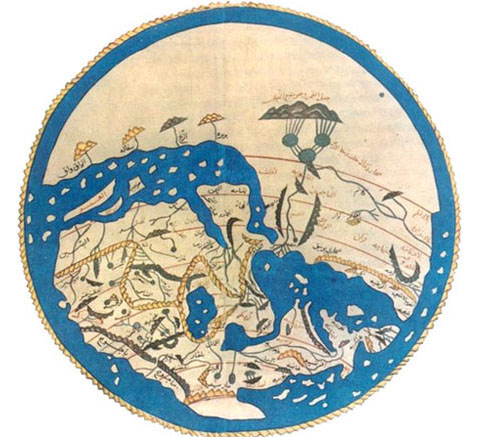
“Medieval & Early Modern Cartography: An Introduction”
Mediterranean Studies Summer Skills Seminar
22–25 June 2026 • Remote
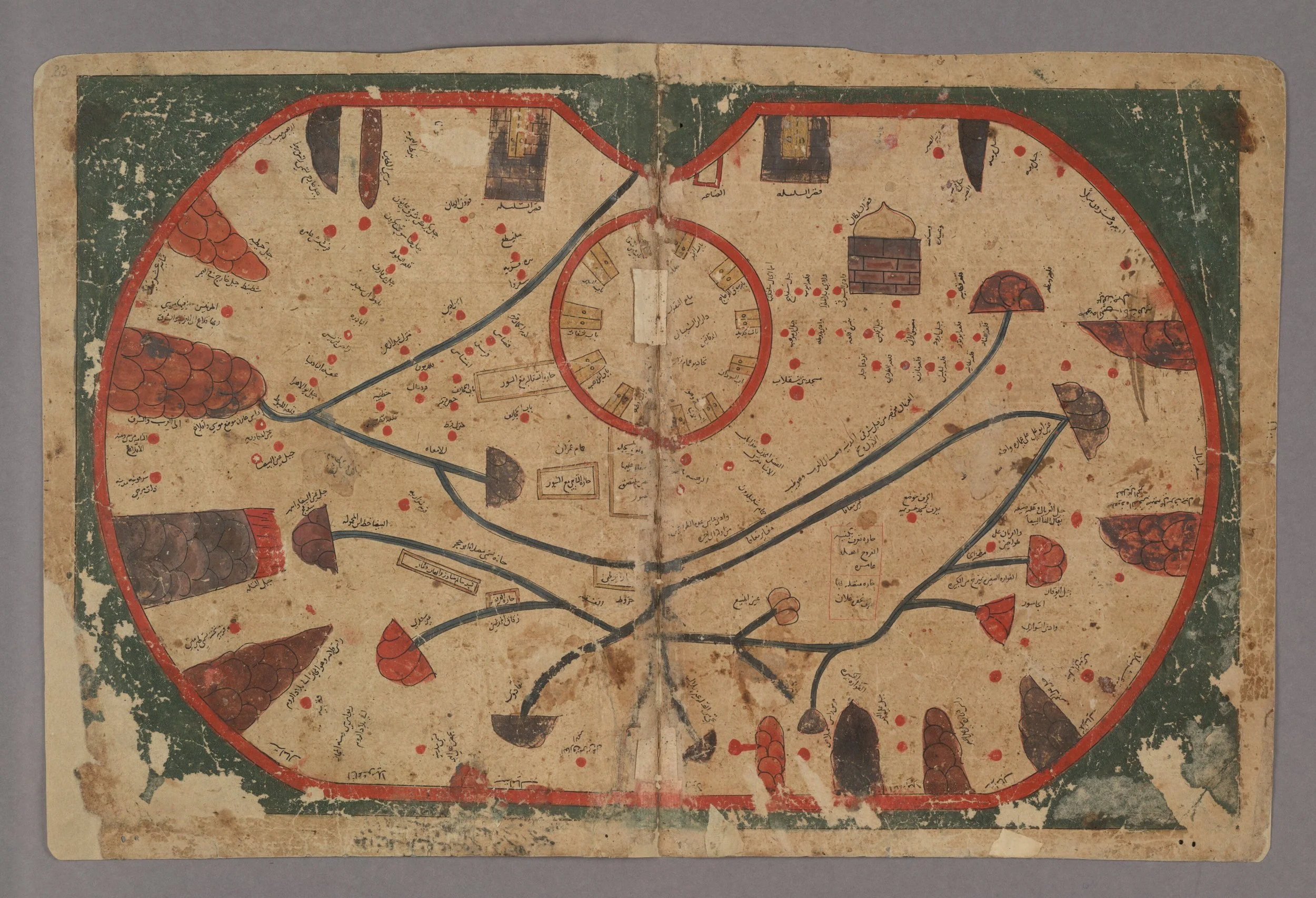
The Summer Skills Seminar, “Medieval & Early Modern Cartography: An Introduction” will be held via Zoom from Monday, 22 June to Thursday, 25 June 2026 from 10am to noon and 1pm to 3pm MDT.
EXTENDED REGISTRATION UNTIL JUNE 17
APPLY HERE
This Summer Skills seminar addresses the importance of maps in medieval and early modern society in terms of their production, function, display, and their contribution to a mapping mentality. Over four days we will study different types of maps from Islamic and Christian territories in relation to their form, content, use, and context. This course will not be addressing the geographic accuracy or scientific basis of cartographic works; rather they will be assessed as material, visual, and aesthetic products and as repositories of a newly formulated system of signs that promoted novel ways of seeing. We will work here to integrate maps more fully into art historical discourses while analyzing them as ideological objects.
Course overview
Course sessions:
Day One will set the stage for an in-depth analysis of cartographic works by asking the question “What does it mean to make a map in the medieval and early modern Mediterranean?” The second topic of the day will be mappaemundi or world maps. These maps constitute some of the earliest cartographic works created in the Mediterranean in both Christian and Muslim traditions. Their close connection to religious communities (as both producers and consumers), spatio-temporal qualities, rich visual imagery, and their melding of religious content and geographical information made them powerful storytelling tools. We will conduct contextual analyses of several world maps to assess the cultural work that maps could perform for an array of patrons and audiences. The availability of digital reproductions of these complex maps will allow course participants to analyze the detailed textual and visual content presented in these cartographic works. We will study a number of world maps, including the Hereford Mappamundi, Fra Mauro’s Mappamundi, and al-Idrisi’s map made for Roger II.
Day Two will focus on a revolutionary new form of mapmaking created during a pivotal moment in the history of cartography: portolan charts and texts from the late twelfth and early thirteenth centuries. Previously mapping had existed almost exclusively in the religious domain but this time period saw the formulation of new cartographic representations that were completely secular in nature and practical in function, created to gauge distances and identify ports and landmarks, while elucidating social customs in foreign locales. We will assess the relationship between navigational charts and traditional world maps while exploring how portolans forged a distinctive visuality for a new audience of mariners and merchants. Some monuments addressed in this class session will include the Carte pisane, navigational charts made by Pietro Vesconte, Abraham Cresques, etc., portolan texts such as the Liber de existencia riverarium, and the Compasso da navegare, and maps from the Fatimid Book of Curiosities.
Day Three will introduce cartographic works that served novel functions in medieval and early modern society. By the fifteenth century, secular mapmaking traditions had become so embedded into cultural practices that they were designed for a broader clientele to serve cultural and political purposes: luxury gifts, political statements, expressions of sovereignty, and displays of wealth and sophistication. We will highlight the transformation of maps into aesthetic objects of prestige that were displayed prominently in public settings. We will also look at highly politicized contexts for maps in which they lay claim to territory and visualize sovereignty in a competitive Mediterranean environment. Some works to be addressed on Day Three include Vesconte’s maps for Marin Sanudo’s Liber secretorum, maps by Opicinus de Canistris, atlases and luxury presentation maps, and painted wall maps for homes and palaces.
The second half of Day Three will comprise theoretical considerations of maps and mapmaking. We will approach the cartographic content addressed in the first three days in relation to various methodologies and new approaches to the study of cartography. How does the visual system of a map create a mapping mentality that defines how people perceive spaces, places, and things? How do maps create communities of inclusion and exclusion? How do maps mean differently depending upon one’s gender, ethnicity, occupation, and/or religious affiliation? What new approaches can scholars and students apply to the study of maps to tap their extraordinary cultural potential? We will end the course with a discussion of new directions in the study of cartography.
On Day Four we will summarize and catalyze the content presented in the first three days of the seminar. How can we characterize the field of Mediterranean cartography and what new questions might we ask of this material? What did the participants learn from the seminar and how might this content and methodology be incorporated into their own research agendas. This will be a day of dialogue and discussion concerning new directions in the study of medieval and early modern cartography.
Past Participants said:
“This seminar more than exceeded my expectations and goals. Professor Mathews is on the cutting edge of thinking about issues regarding medieval and early modern cartography from an art historical perspective, including her work in digital mapping.”
“The class was very helpful and gave me the footing I was seeking to think more carefully on a history of cartography. It was a quick immersion in key scholarship and the instructor provided thoughtful and well-guided discussion on narrow and broad topics within cartography.”
“Now with the materials provided, I have a roadmap to follow in my future studies. Understanding milestones, prominent figures, paradigms and paying attention to "what we can pay attention to" in cartography were extremely helpful for me.”
“The course was extremely well designed to introduce specific works of mapping from differing cultural traditions. Professor Mathews offered theoretical and historical context for these works, and she consistently raised the level of interpretation. Importantly, she was comfortable with the fact that there are no easy answers in understanding some of these early maps.'“
“I enjoyed participating in the workshop, hearing from other scholars with different levels of experience in this research area, viewing the numerous mapping examples from the time period, etc. It was a stimulating class that prompted stimulating discussion.”
“I have found Professor Mathews's published research both inspiring and helpful in thinking about my own studies, and the insights and reflections she shared from her current research were very exciting and relevant to my own work.”
“Not only do I have readings (new to me) that I plan on integrating into my Medieval Mediterranean survey, but I also can imagine teaching one of the units on a "Mediterranean way of seeing."
“I learned to think about art in a deeper way. I plan to incorporate what I learned into my own courses by asking Mediterranean questions related to the art work that we study.”
“In just four days Professor Mathews covered a lot of ground and provided a rich syllabus; she took a collaborative approach and participants were able to add bibliographic sources to the drop box folder.”
“Wonderful course and professor. Left me wanting more!”
“This was an intense immersion in Mediterranean topics, with excellent readings and guided questions.”
“Karen was very skilled at turning comments and questions from the participants into teachable moments. The range and depth of her knowledge were easily apparent.”
“The professor was excellent. Karen Mathews was well-prepared and thoughtfully selected the readings and the material that was covered. She was attentive to every student in the course.”
“The course was very well organized, and I especially appreciated the opportunity to discuss ideas with scholars and enthusiasts from a wide range of disciplinary backgrounds and research interests. The diversity of perspectives enriched every conversation and created a genuinely stimulating intellectual environment. It was an immensely rewarding experience.”
“Prof. Matthews did an EXCELLENT job of providing the most up-to-date materials, setting clear daily goals and providing daily readings and overviews in advance, and in keeping the class well-paced and on-track. She's not only a wealth of information and a valuable scholarly resource, herself, but offered an excellent example for how to run a class.”
“Take this course if you are new to learning about cartography or if you are well experienced in it. In both cases, you will learn a great deal in Prof. Matthews' course and come away with excellent resources from which to continue to build your knowledge.”
“Karen Mathews put together a very well-organized and informative seminar on cartography, providing all the tools for my future research.
“This was a fabulous course. Karen is an exceptional academic and teacher, and provided a rich corpus of materials to analyze. I would highly recommend it to anyone interested in the topic. “
Faculty

The course will be conducted by Prof. Karen Rose Mathews (Department of Art and Art History, University of Miami). She received her B.A. in Art History from UCLA and a M.A. and Ph.D. in Art History from the University of Chicago. She has received grants from the Graham Foundation, Kress Foundation, Program for Cultural Cooperation, and the American Research Center in Egypt in support of her research. She published Conflict, Commerce, and an Aesthetic of Appropriation in the Italian Maritime Cities, 1000-1150 (Brill) in 2017 and was lead editor for the volume A Companion to Medieval Pisa (Brill, 2022). Her numerous articles focus on various aspects of medieval Mediterranean visual culture, with a particular emphasis on artistic production in Spain, Italy, and Egypt, including a comparative assessment of civic ceremonial and its architectural framing published in 2025. She has been conducting research on Mediterranean cartography since 2015. An article published in 2022, “Mapping, Materiality, and Merchant Culture in Medieval Italy, 1150-1400,” studies the relationship between cartography, architectural decoration, and new visual systems in the Italian maritime republics. Two more articles in preparation assess Islamic and Christian cartographic traditions in terms of their use in navigation, the perspective they provide on the Mediterranean, and their creation of a new visual vocabulary of signs.
Prerequisites & preparation
Recommended prerequisites: AP Art History courses or introductory surveys. Some upper division or graduate art history coursework is ideal but not required
Please note: sessions will not be recorded; synchronous attendance is required.
Application & Information
The regular application period is until April 26.
There is an application deposit of $100USD or €100. This will be refunded when course payment is made.
Late applications will be accepted if there is availability and will be subject to a late fee.
If you are not accepted your application deposit will be refunded.
Applicants will be advised of acceptance by May 1. Payment is due on 15 May. Applicants waiting on a grant or subvention should contact us without delay to make arrangements.
Late applicants may be accommodated if space remains. For late applicants full payment will be due within three days of acceptance, including a $75 surcharge for late applications, or be subject to an additional fee.
All payments are final and non-refundable. A letter of confirmation/ receipt will be provided by the Mediterranean Seminar, together with a certificate of completion once the course has concluded.
Apply via this form
NOTE: Numbers are limited; participants are encouraged to apply early.
Fees
There has been no increase in fees for 2026
• $1100 for Full Professors, Librarians & Professionals
• $825 for tenured Associates, Emerita/us, Retired Faculty, Independent Scholars & Non-Academics;
• $575 for non-tenured Associates and Assistants, Postdoctoral Fellows & Graduate and Undergraduate students;
• $400 for Adjuncts, Lecturers & Contingent faculty.
Limited reductions are offered to applicants who are (1) nationals; (2) current residents; (3) AND faculty or students in low-per-capita GDP countries may apply for a reduction (the Low-GDP Bursary program).
Payment information will be provided at the time of acceptance. Posted fees do not include a 5% processing fee.
How do we determine our fees?
Can I get a reduction in fees?
Why are there sometimes supplementary charges?
Why have our fees gone up?
What is the low-GDP Bursary program?
Proposed Program
Monday, 22 June 2026: Introduction and Mappaemundi
10am to noon and 1pm to 3pm
1. Introduction to cartographic visuality
2. Mappaemundi—Patrons, audiences, and storytelling potential
Tuesday, 23 June 2026: Portolan Charts and Text
10am to noon and 1pm to 3pm
1. Secular mapmaking traditions—function and audience
2. Relationship of portolans to traditional world maps
Wednesday, 24 June 2026: Novel Uses for Maps and Theoretical Approaches to Cartography
10am to noon and 1pm to 3pm
1. Novel uses for navigational charts and world maps
2. Theoretical Approaches: Maps and/as Representations
Thursday, 25 June 2026: Conclusions and Participant Presentations
10am to noon and 1pm to 3pm
1. Conclusions
2. Participant Presentations
Important dates:
Application period: 26 April 2026
Acceptance/stand by notifications: 5 May 2026
Full payment: 12 May 2026 (subject to extension for late applicants/ or pending grants)
NOTE: Numbers are limited; participants are encouraged to apply early.
Information
For general information regarding fees, enrollment, and administrative matters, contact the Mediterranean Seminar; for questions regarding seminar content and materials, contact the instructor directly.