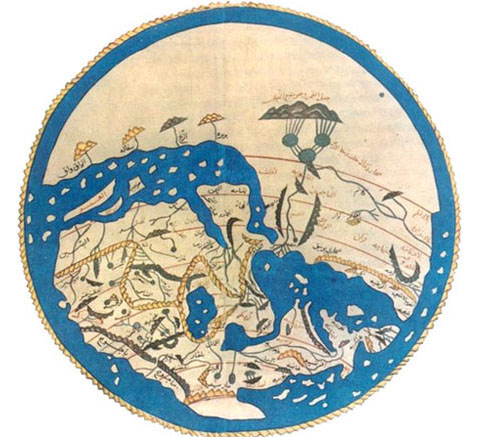
“Reading Medieval Greek Manuscripts”
Mediterranean Studies Summer Skills Seminar
18—21 May 2026 • Remote

The Summer Skills Seminar, “Reading Medieval Greek Manuscripts” will be held via Teams from Monday, 18 May to Thursday, 21 May 2026 from 10am to noon and 1pm to 3pm MDT.
Course overview
This course offers a practical introduction to Greek paleography with a strong emphasis on hands-on learning. Participants will explore Greek manuscript culture through an introduction to paleography and the evolution of Greek script. The seminar aims to equip participants with the skills to independently read and interpret Greek manuscripts, provide a solid foundation for further research in the study of Greek language and book culture, and enable participants to access and utilize primary Greek sources for various research purposes, from historical to linguistic analyses. The seminar includes sight-reading exercises and practical sessions with a range of manuscript texts, allowing participants to progressively develop their reading skills and become familiar with different script forms.
Some comments from participants:
“I felt my skills grow exponentially over the days of the seminar and I appreciated the time dedicated to reading for ourselves.”
“The course was excellent. In each session our professor provided to us important and fascinating information, while guiding us through new and challenging material in a thoughtful and encouraging way. It was an inspiring 4 days and I am sorry the course had to end!”
“The course did a great job laying the foundations of Greek manuscript studies in a limited amount of time.”
“I have doubts whether I would have been as satisfied if this course had been taught by someone else. Because he was not only an expert in his field, also he was able to manage a group by paying attention and giving courage to each of the participants; and the participants worked with him for hours without ever losing their attention and interest.”
“The course was useful, stimulating, and a lot of fun!”
“Dr. Ulbricht was very kind, and made the intimidating prospect of reading from manuscripts aloud quite approachable.”
“The instruction and format were excellent. In addition to the interesting overviews, helpful resources, and hands-on approach by practicing reading, I appreciated that the instructor asked about our experience regularly and invited feedback.”
Faculty

Dr. Manolis Ulbricht is a Faculty member at the University of St. Thomas, Houston, Texas (Department of History, Core Fellow) and scholar in Byzantine and Medieval Greek Studies. With expertise in Greek paleography, codicology, and textual criticism, Ulbricht makes extensive use of the Greek manuscript tradition in his work. Most recently, and in cooperation with the Staatsbibliothek Berlin, Germany, he produced several teaching films on Greek and Arabic paleography, codicology, and the use of metadata.
Program
Monday, 18 May 2026
10am to noon and 1pm to 3pm
1. Introduction & Biblical Majuscule
2. Majuscules until the 10th century
Tuesday, 19 May 2026
10am to noon and 1pm to 3pm
1. The Shift from Majuscule to Minuscule Script
2. Minuscules of the 9th and 10th Century
Wednesday, 20 May 2026
10am to noon and 1pm to 3pm
1. Minuscules of the 11th-12th
2. Research Techniques
Thursday, 21 May 2026
10am to noon and 1pm to 3pm
1. Minuscules of the 13th-14th Century
2. The Late Byzantine Period and Early Printed Books
Participants
Patricia Ahearne-Kroll (Classical & Near Eastern Religions & Cultures, University of Minnesota)
I have a Ph.D. from The University of Chicago Divinity School (Biblical Studies, specializing in Hebrew Bible and Second Temple Judaism). My language training includes Classical Greek (especially Hellenistic literature); Classical Hebrew; and Middle and Late Egyptian.
In my teaching and research, I have examined several topics related to religious practices in the Hellenistic and early Roman periods and how these practices operated at local levels, especially in terms of political power and identity formation. My work on “Artapanus” and my book, Aseneth of Egypt, contribute to this discussion about Jewish identity politics by connecting these literary traditions with papyrological, epigraphical, and archaeological evidence from Ptolemaic Egypt. My work on the ancient Jewish novel, “Aseneth,” has led me in a new direction in the study of Pseudepigrapha (a classification of literature related to biblical texts and preserved in later, often Christian, codices). I am currently completing a Hermeneia commentary on “Aseneth” (a.k.a., “Joseph and Aseneth”) that branches out from the typical format for that series. I am providing a translation and commentary of three distinct Greek texts of the story, and I am analyzing their placement and use in their respective codices (dating between the eleventh and seventeenth centuries). I am interested in the book history of these individual tellings, and building upon my first book, I continue to challenge the use of eclectic texts in the study of Judaism in antiquity.
Relevant Publications and Research:
Joseph and Aseneth: A Commentary. Hermeneia Series. Fortress Press (in contract).
Aseneth of Egypt: The Composition of a Jewish Narrative. Early Judaism and Its Literature series. Atlanta: Society of Biblical Literature, 2020.
"A History of the Study of Pseudepigrapha.” Pages 103–131 in The Old Testament Pseudepigrapha: Fifty Years of the Pseudepigrapha Section at the SBL. Edited by Matthias Henze and Liv Ingeborg Lied. Early Judaism and Its Literature series. Atlanta: Society of Biblical Literature, 2019.
“Joseph and Aseneth.” Pages 2525-2589 in Outside the Bible: Ancient Jewish Writings Related to Scripture. The University of Nebraska Press, 2013. (Translation of and annotated commentary on the Greek text of “Joseph and Aseneth.”) “Constructing Jewish Identity in Ptolemaic Egypt: The Case of Artapanus.” Pages 434- 456 in The “Other” in Second Temple Judaism: Essays in Honor of John J. Collins.Edited by Daniel C. Harlow, Karina Martin Hogan, Matthew Goff, and Joel S. Kaminsky. Grand Rapids: Eerdmans, 2011.
Jackson Ellard (History: Georgia State University)
My interest in this class and Medieval Greek stems from my interest in the religious and social developments during the Late Antique and Early Medieval periods. I have worked on Greek Medieval and Late Antiquity history for the past year and a half and will continue my research on this period during my master’s at GSU this fall. I have specifically done research into the Origenist Controversy in the fourth century. In my time researching this controversy I have looked into both the theological issues that were discussed as well as the historical and political reasons for the controversy occurring. Aside from my work on this event, I have done research into gender diversity in Early Medieval hagiography and how we can justify the use of modern queer terms to discuss historical figures without being anachronistic. I have also taken one class on ancient Greek through Oxford Latinitas and have self-studied since then. Overall I am interested in how the early developments of Christianity shaped the gender performance and social norms during that time. I am currently in between my last undergrad semester and first full time graduate semester at Georgia State University and am continuing my research on the Origenist Controversy for my Thesis.

Talia Gordon (Art History:McGill University)
Talia Gordon is a PhD student in the Art History department at McGill University. In the spring of 2025, she completed her MA at the University of California, Irvine, where her thesis explored the lithic materiality of late Byzantine micromosaics as collected by the quattrocento Medici. She earned her Batchelor of Arts from the University of Pennsylvania. At McGill, she plans to explore the latent ecologies of Byzantine material culture in cultural transition at the edges of the empire, both east and west.
Julia Lillis (Union Theological Seminary)
Julie Kelto Lillis teaches courses in early Christian history at Union Theological Seminary in New York City. She holds a B.A. from St. Olaf College, M.Div. and Th.M. from Princeton Theological Seminary, and Ph.D. from Duke University. Most of her research focuses on gender and sexuality in late ancient texts, drawing especially from Christian texts in Greek, Latin, and Syriac. Her first monograph, Virgin Territory: Configuring Female Virginity in Early Christianity (University of California Press) traced the rise of a new “common sense” about virgins’ bodies in late antiquity amid varying definitions for virginity. A 2026-27 ACLS Fellowship will support her current book project, Genderlessness: Early Christian Horizons, which examines the intermittent early Christian impulse to imagine (and sometimes enact) life beyond gender. Her other interests include the ways ancient societies understood health, illness, and disability, and she co-directs the international academic working group ReMeDHe (“remedy”): Religion and Medicine, Disability, and Health and Healing in late antiquity.
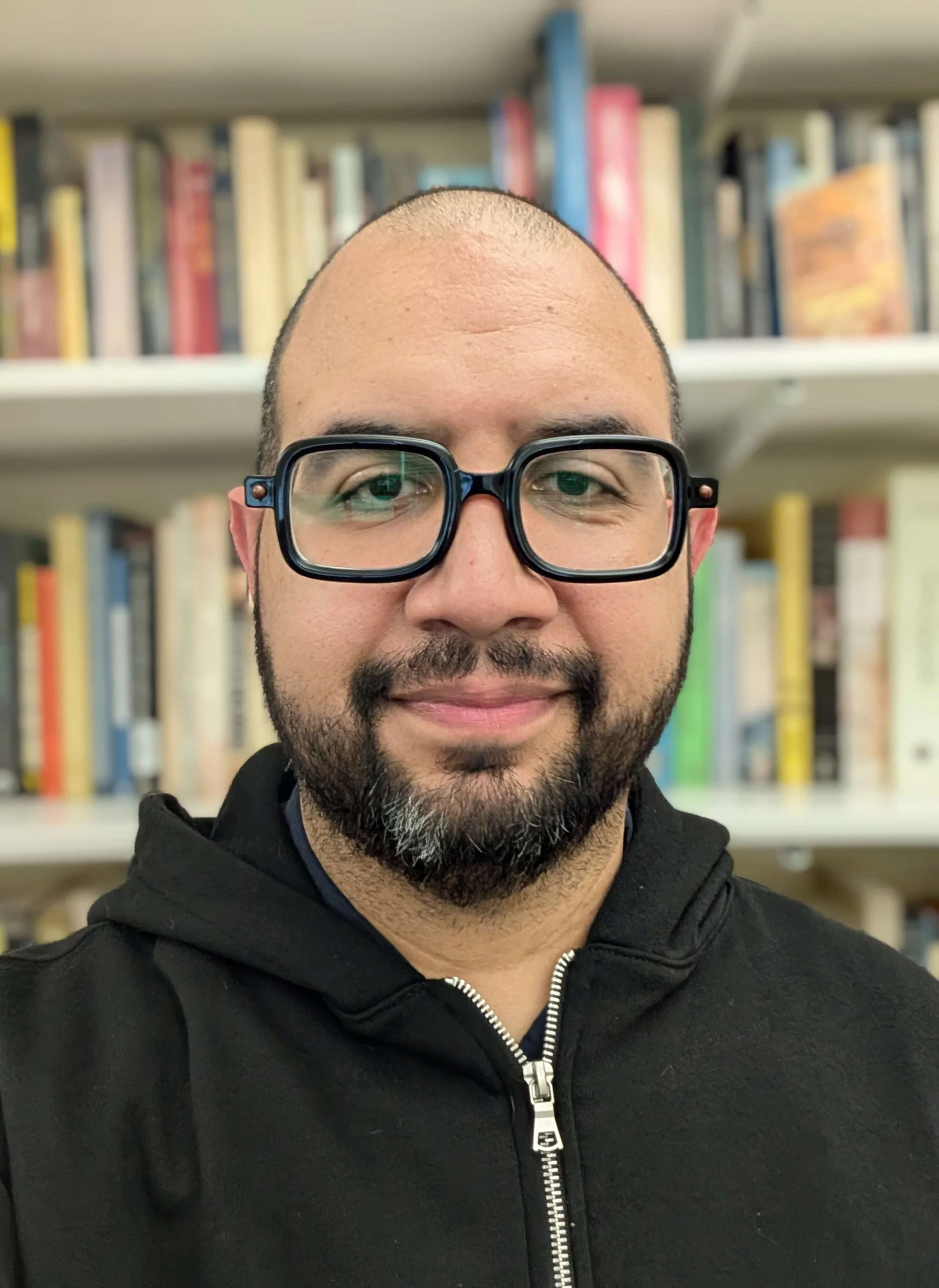
David Maldano (Religious Studies: Kenyon College)
David Maldonado Rivera is Associate Professor of Religious Studies at Kenyon College. His areas of research include discourses of expertise in late ancient Christian heresiology and fifth-century church historiography, and the reception of late ancient and early medieval legal tropes in early twentieth-century Spanish Caribbean literature. His current projects are a translation of Sokrates of Constantinople's Church History (with Jeremy Schott and Rebecca Falcasantos), an anthology and translation of Latin heresy manuals (with Young Richard Kim), and a monograph titled False Starts: Making Christian Heresiology in Late Antiquity.